To make your platform more flexible and improve your users' experience, you can offer business accounts to your users.
Account structure
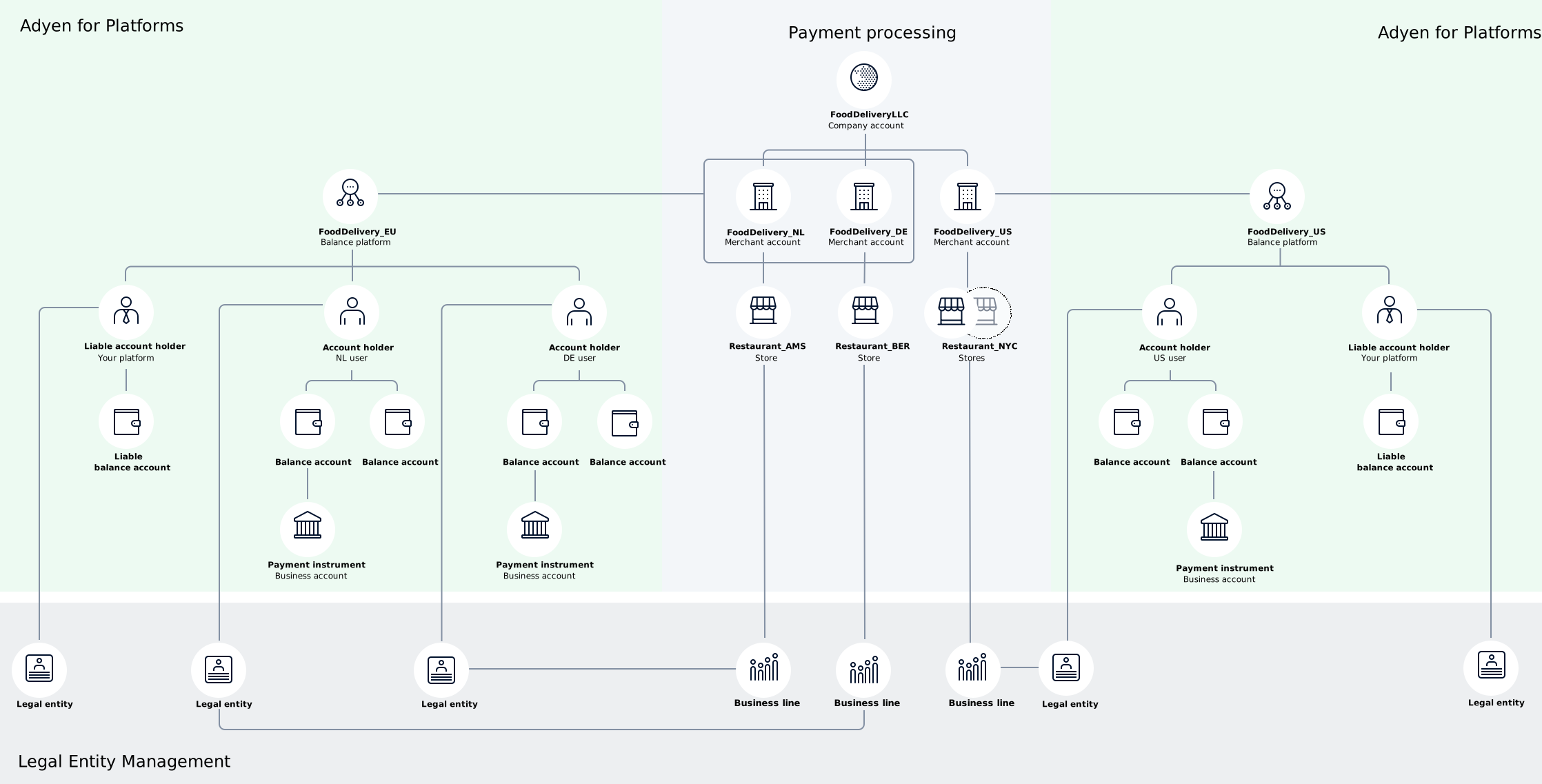
To comply with payment scheme regulations, you must have a balance platform and merchant account in each region that you are registered and wish to process transactions.
For example, you have a large food delivery company called Food delivery, where your users are delivery drivers and restaurants. You want to create business accounts for the restaurants to pay their suppliers and partners.
You can classify resources based on whether they belong to your platform or to your user(s).
Resources belonging to your platform
-
A company account (FoodDeliveryLLC), that represents your business entity.
-
Three merchant accounts, organized by country/region, to manage payment methods available in their area:
- FoodDelivery_NL
- FoodDelivery_DE
- FoodDelivery_BE
-
Two balance platforms, one for each region in which you acquire payments (EU and US).
- FoodDelivery_EU
- FoodDelivery_US
-
A liable account holder for your platform, and a liable balance account to hold your platform's funds.
-
A legal entity in each acquiring region, containing information about your platform.
Resources belonging to each user
-
One or more stores tied to the respective merchant accounts (based on country of operation), representing your user's restaurant locations:
- Restaurant_AMS
- Restaurant_BER
- Restaurant_BRU
-
At least one account holder for each country your user operates in, defining their transfer capabilities.
-
For each account holder, at least one balance account with a defined base currency, to hold your user's funds.
-
For each account holder, one or more balance accounts to link to your user's business accounts (payment instruments). If your user has multiple business accounts, you can link them all to the same balance account. However, that balance account must be separate from the balance account that holds your user's funds.
-
For each balance account, a transfer instrument (verified bank account) to pay out that account's funds.
-
A legal entity in each country your user operates in, containing information about their business. This information is needed for the required verification checks (KYC).
-
A business line in each country your user operates in, containing information about their industry. In this case, it is food and delivery services.
-
A payment instrument, whose transactions are processed using the funds in your user's balance account:
- A business account for each restaurant, that they can use to pay their suppliers and partners.
Diagram
The following diagram shows how these resources are connected.