


Learn how to reconcile your Adyen Payment Processing invoice with transaction-level reporting. Using our Interactive Payment Accounting Report (IPAR), you can verify your invoiced charges, check already deducted fees, and audit monthly turnover amounts.
Requirements
Before you start reconciling your invoice, make sure you have:
- An active user account for your Customer Area with one of the following user roles:
- Merchant admin
- Merchant report role
- Merchant financial
- Merchant POS Report role
- A clear understanding of your invoice layout. Learn how to read your invoice.
Understand your invoice
The Adyen Payment Processing invoice shows all processing fees, interchange costs, and scheme fees accrued during the billing period. Fees already deducted from your daily settlement payouts are listed under the Already Deducted fees line item, so they are not charged twice.
The Invoice Final Calculation subtracts these prior deductions from your total gross fees:
- If gross fees exceed the amounts already deducted, the remaining balance is shown as the Total Amount Due.
- If the amounts already deducted exceed gross fees, the difference is shown as the Total Amount Credited.
- If the two amounts are equal, the balance is zero and no further action is needed.
Determine your amount due
The Amount due line under the Summary section of your invoice equals the costs calculated at the end of the month, minus the Already Deducted fees amount. Your Amount due will be added to or deducted from your next payout by default and will appear as an Invoice deduction entry in the corresponding Settlement details report.
Interactive Payment Accounting Report
The primary tool for matching invoiced costs with individual transactions is the Interactive Payment Accounting Report (IPAR). The IPAR is the most accurate report for invoice reconciliation because it contains all payment lifecycle status changes, required turnover amounts, and invoiced fee amounts for the date range covered by your invoice. The IPAR also allows you to reconcile the Already Deducted fees section of your invoice, and end-of-month transaction fees.
You can generate the IPAR at the company level, or for individual merchant accounts.
Other reports, such as the Monthly Finance Report and Settlement details report, only support partial reconciliation. These reports lack the transaction granularity and timezone cutoffs required for a full financial reconciliation.
When you generate an IPAR, you define a custom date range and timezone. Because Adyen issues invoices in the Central European Time (CET) timezone, the IPAR is ideal for manual, one-off reconciliations. When generating this report manually, limit your selected date range to a single month, as large date ranges require extended processing time.
IPAR columns
You need to configure the following columns in your IPAR to reconcile your payment invoice:
| Column name | Purpose for reconciliation | Invoice fee line |
|---|---|---|
| Merchant account | Identifies the merchant account used to process the original payment request. Use this to reconcile merchant-specific charges at the company level. | Relevant for company level invoices |
| PSP Reference | Adyen's unique 16-character reference for the transaction. | |
| Booking date | The timestamp when Adyen's accounting system recorded the event. | |
| Record Type | The payment event status used to calculate costs. For a complete list, see Record types. |
|
| Payment Requester Type* | Identifies the payment requester. Use this to filter and reconcile AutoRescue Service fees. |
|
| Payment Method | Identifies the payment method. Use this to filter and reconcile payment method fees. |
|
| Payment Currency | The three-character ISO currency code used to process the payment. | |
| Settlement Currency | The three-character ISO currency code used to settle the payment. | |
| Received (PC) | The amount used to calculate turnover for processing fees, in the payment currency. | Used to calculate the figure in the Turnover column of the payment processing invoice. |
| Authorised (PC) | The amount used to calculate turnover for authorisation scheme fees, in the payment currency. | |
| Captured (PC) | The amount used to calculate turnover for payment method fees and refund fees, in the payment currency. | |
| Processing Fee (FC) | The processing fees deducted during the month, in the processing fee currency. | Processing Fees |
| Commission (SC) | The commission blend fees deducted during the month, in the settlement currency. | Commission Blend (for example, amex) |
| Markup (SC) | The commission markup fees deducted during the month, in the settlement currency. | Commission Markup |
| Interchange (SC) | The interchange fees deducted during the month, in the settlement currency. | Interchange Issuing Banks |
| Scheme Fees (SC) | The scheme fees deducted during the month, in the settlement currency. | Authorisation Scheme fee |
| Network Token Used* | If TRUE, a network token was used to authorize the payment. | Network tokenization service |
| Network Token Available* | If TRUE, a network token was available for the payment. | Network tokenization service |
| Risk Premium* | Identifies transactions screened by Protect. | Revenue Protect Service |
| DCC Markup (SC)* | The Dynamic Currency Conversion markup amount, in the settlement currency. | |
| Payable batch | The batch number for the payable batch. |
* This column is not enabled by default.
Generate your IPAR
To generate an IPAR for reconciliation of a payment processing invoice:
- Log in to your Customer Area.
- Go to Reports > Reports overview and select the Interactive payment accounting report.
- Configure the columns you need for your invoice reconciliation:
- Select the Column configuration tab.
- Check the columns you need, and reorder them as needed.
- Select Save configuration.
- Select Generate.
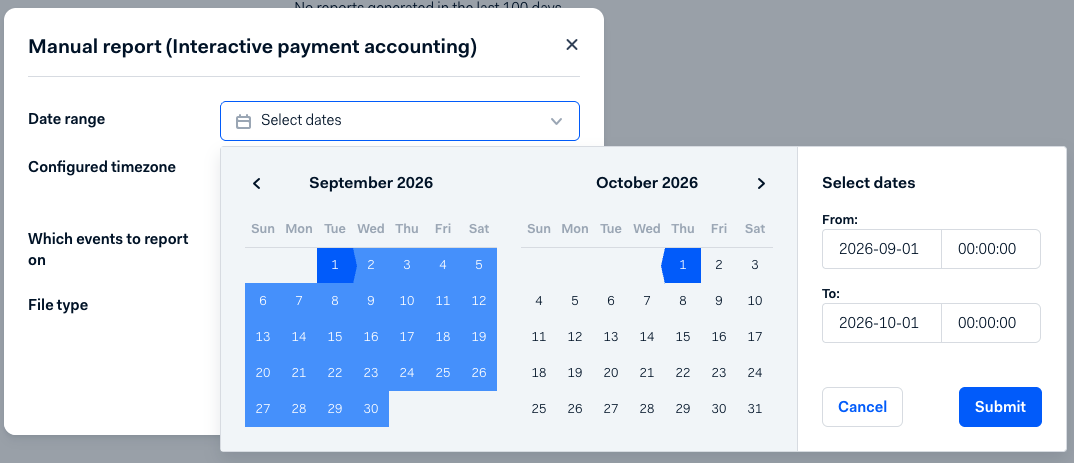
- Set the Date range to start on the first day of the invoice month at 00:00:00 and end on the first day of the following month at 00:00:00.
For example, for a September invoice, select the following date and time range:
From:
2026-09-01 00:00:00
To:
2026-10-01 00:00:00
- Set the Configured timezone to Central European Time.
Adyen generates invoices in this timezone regardless of your account location. - Set the Which events to report on value to Select all.
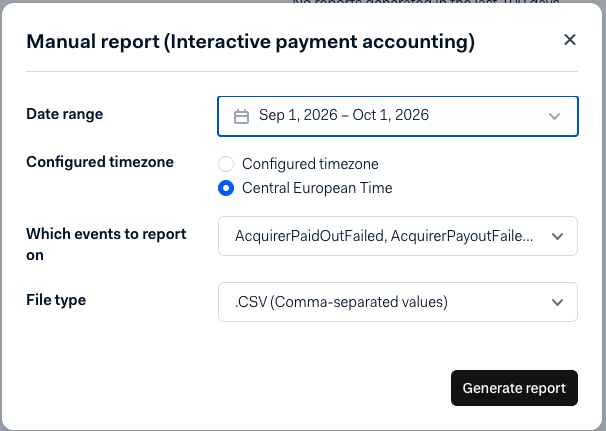
Example for September 2026 IPAR settings to reconcile a September 2026 payment processing invoice. - Select Generate report.
It may take up to three hours for your IPAR to generate. - Check that your generated IPAR appears in the Generated reports list.
Reconciliation logic
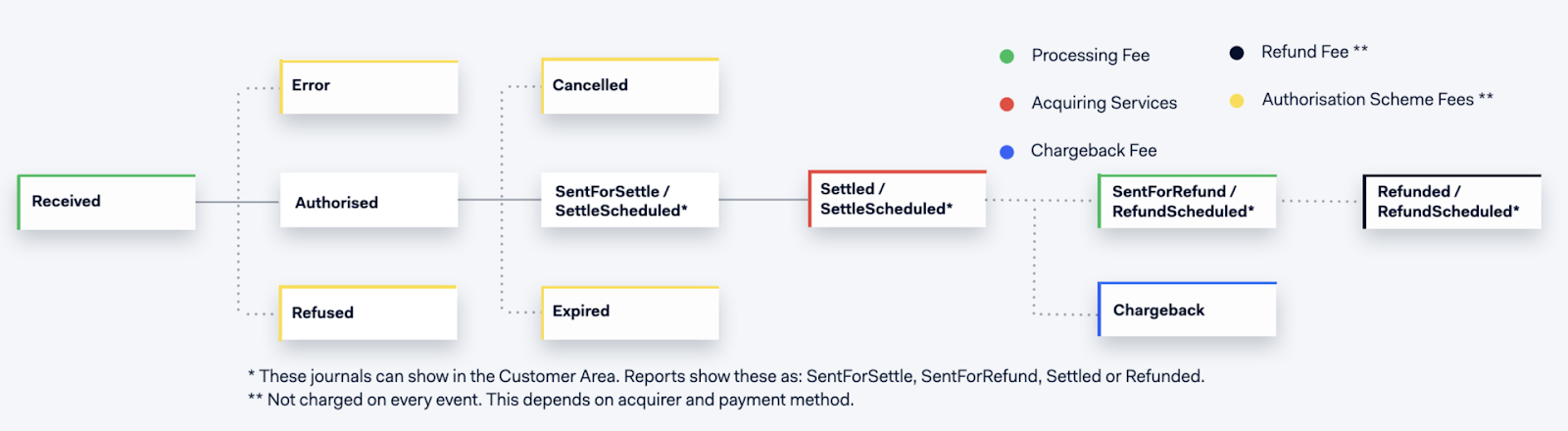
The following payment lifecycle diagram shows when fees occur in the payment lifecycle. This can help you understand which transaction events to use as filters to reconcile your invoice.
Use the Record Type column in your Interactive Payment Accounting Report to match transaction events with payment processing invoice line items.
Processing fees
Adyen calculates processing fees from the count of transactions initiated during the month.
- Already deducted amount
- Filter the Record Type column in your IPAR by the following journal values:
- Received
- SentForRefund
- ReceivedIncrementalAuth (if you process authorization adjustments)
- Sum the values in the Processing Fee (FC) column.
This total matches the Already deducted processing amount on your invoice.
- Filter the Record Type column in your IPAR by the following journal values:
- Final calculation
- Multiply the total count of initiated transactions by your contracted Processing service rate.
- Processing turnover
- Sum of the values in the Received (PC) column.
Note: Transactions marked as Received that our risk engine refuses or that settle externally, or entries with the payment method as Unknowncard still incur a processing fee. Adyen calculates fees for these transactions at the end of the month when generating the invoice. The Processing Fee (FC) column is blank for these rows in the report. The total count matches the invoice, but the report sum only matches the already deducted amount.
Match processing fees to your invoice
In your invoice, under the Specification of amounts already deducted from the settlement section, you can see the total processing fees as Subtotal in the Processing Fees table.

Look at the Summary section of your invoice.
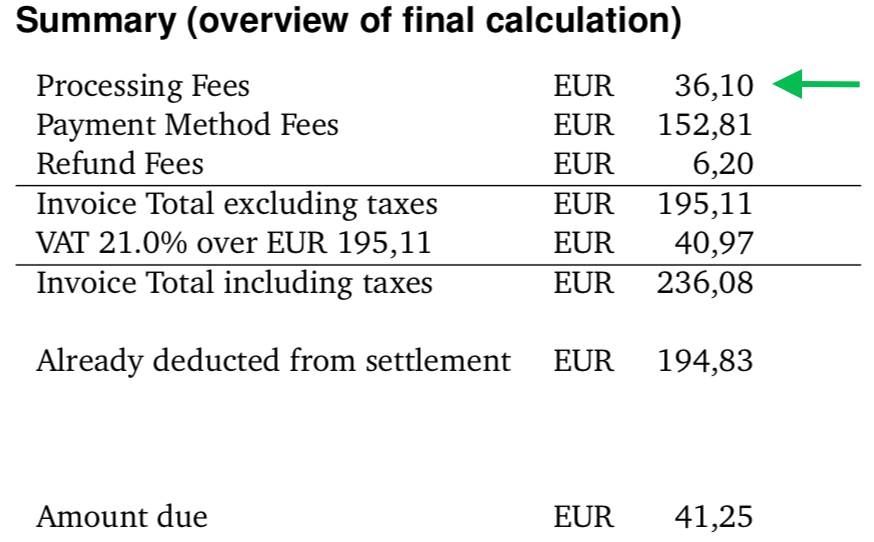
If the amount of total processing fees doesn't equal the amount in the Processing Fees line item, then go to the Specification of final calculation including discounts section of the invoice.

If you need to pay additional fees, you see additional lines in the table. For example, there can be additional lines showing processing fees from transactions settled by other acquirers and fees on transactions refused by our risk engine.
Payment method fees
Payment method fees include authorisation scheme fees and fees for settled transactions.
Authorisation scheme fees
Authorisation scheme fees apply to non-settled transactions under the Interchange++ pricing model. Adyen invoices these fees at the end of the month for the following events:
Authorisation Scheme fee Authorised: Zero-authorization transactions (The Record Type column with a journal value of Authorised).
Authorisation Scheme fee Cancelled: Cancelled transactions (The Record Type column with a journal value of Cancelled).
Authorisation Scheme fee Refused: Refused transactions that were not retried, or the second refusal in a retried transaction (The Record Type column with a journal value of Refused).
Authorisation Scheme fee Refused retries: The first refusal in a retried transaction (The Record Type column with a journal value of Retried).
To reconcile Authorisation scheme fees:
- Filter the Record Type column by the relevant journal event statuses:
- Authorised
- Cancelled
- Refused
- Retried
- Sum the values in the Scheme Fees (SC) column.
The invoice lists the count of transactions that incurred the fee, not the total count of all authorised or cancelled transactions.
Reconcile acquiring and payment method fees
Acquiring and payment method fees are charged only when a transaction reaches the Settled status. To see these fees in your report, find the transaction records with the Record Type: Settled.
See the amounts in the following columns:
- Commission: A fee paid for the use of a payment method. The fee amount is determined by the payment method.
- Markup: A fee paid for certain card payments or for currency conversion between processing currency and settlement currency. The fee amount depends on the type of card payment or currency conversion rates.
- Scheme Fees: A fee paid to the card scheme for each payment transaction made with the card scheme. The fee amount is determined by the corresponding card scheme.
- Interchange: A fee paid to the issuer for each payment transaction made via a card network. The interchange fee amount is determined by the corresponding card network. A further fee is deducted from the total by Adyen before paying into your merchant account.
Add all these amounts together for the total acquiring and payment method fees. On your invoice, this total and the itemized list of fees are under the section with the calculated amounts.
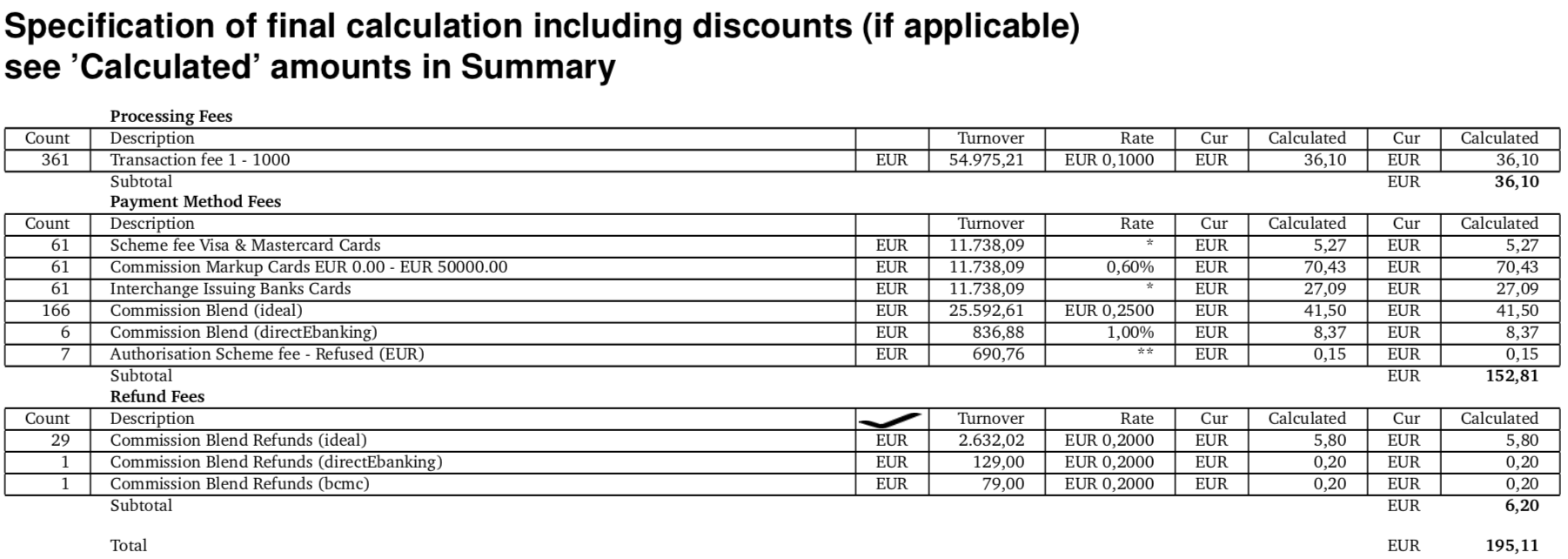
To reconcile fees for settled transactions:
- Filter the Record Type column by the Settled journal events.
- Sum the values across the following columns:
- Commission (SC)
- Markup (SC)
- Interchange (SC)
- Scheme Fees (SC)
This summed value matches the already deducted amount.
- Turnover = Captured (PC) column
Already deducted amount: Filter the Record Type column by the Settled journal events and sum up the values across the four fee columns mentioned above.
Depending on your pricing agreement, you might also need to use the Payment Methods column to obtain a cost breakdown for specific payment methods.
For example, to reconcile payment method fees for Amex (Commission Blend (amex) invoice line), you need to:
- Filter on the Record Type column with a journal event value of Settled;
- Filter on the Payment method column with a value of Amex;
- Sum the values in the Commission (SC) column.
If you need to see in which payable batches these transactions were Settled, received a Refund, or been marked as a Chargeback, you can refer to the Payable Batch column in the Interactive Payment Accounting Report for each of these journal event values. The same holds for Refund and Chargeback fees.
Final calculation: For any transactions where the fee is a fixed rate over the transaction amount, the final calculation of this fee on the invoice is based on the total monthly turnover. Therefore, you need to sum up the values in the Captured (PC) column and calculate the final fee amount as a percentage of that.
Note that this is only relevant for the Commission Blend or Commission Markup fees, as Scheme Fees and Interchange Fees and passed on from the relevant schemes and issuing banks, and their rates may vary.
Locate discrepancies for payment method fees
If the amount in one of the Payment Method Fees lines under the Specification of final calculation including discounts section does not equal the amount in the corresponding line under Specification of amounts already deducted from settlement, it may be due to a rounding difference.
For example:
The commission markup for a payment method is 0.5%.
You process 100 transactions, each with an amount of USD 1.00.
The amount in the line under Specification of amounts already deducted from settlement is calculated for each transaction:
100 x (USD 1.00 x 0.5%) = USD 0.00.
The amount in the line under Specification of final calculation including discounts is calculated for the aggregated transaction amount:
(100 x USD 1.00) x 0.5% = USD 0.50.
Refund and chargeback fees
Refund and chargeback fees apply to all refund and chargeback journal events.
To reconcile these fees:
- Filter the Record Type column by the following refund or chargeback journal event values:
- Refunded
- Chargeback
- SecondChargeback
- ChargebackReversed
- Sum the values across the following columns:
- Commission (SC)
- Markup (SC)
- Interchange (SC)
- Scheme Fees (SC)
The reconciliation logic is the same as for the Payment Method fees described above.
Non-transactional scheme fees
Non-transactional scheme fees apply to processed payments that are not net-settled. Adyen calculates these fees across an aggregated set of transactions.
You cannot reconcile non-transactional scheme fees using the Interactive Payment Accounting Report. Instead, use the Non-Transactional Scheme Fees report.
Taxes
Adyen does not deduct taxes during the month. Taxes are calculated and applied directly on your monthly invoice.
Tiering - How it works
Throughout the month, we deduct fees at the price of the first tier. For example, if the first tier is EUR 0.10 per transaction, EUR 0.10 is deducted for each transaction.
At the end of the month, we apply the tiers. All transactions from all merchant accounts under your company are aggregated on the company-level invoice, which shows the volume in each tier. From this, we calculate the average fee for the month, and the difference with what was deducted during the month is trued up on the invoice.
On each merchant-level invoice, the Rate column shows this average value. Because every merchant account is charged the same average, all accounts benefit equally from the company-wide tiering. If your volume reaches the top tier, the Rate column shows the rate of that tier instead of an average.
Additional fees
The following additional fees may appear on your payment processing invoice:
Accelerated Sales Day Payout
The Accelerated Sales Day Payout (ASDP) fee is charged for all transactions settled using ASDP. To find them in the Interactive Payment Accounting Report:
- Filter on the Record Type column with a journal value of Settled.
- Count the transactions settled using ASDP.
- Compare this count with the ASDP line item on your invoice.
Note: Additional filtering may be required, for example on a merchant account or region. Follow your contract to determine which filters apply to your setup.
Account Updater service
The Account Updater service enables merchants to automatically update stored card details of their shoppers. Keeping this data up-to-date may be critical for accepting recurring payments.
The Account Updater service fee cannot be reconciled with the Interactive Payment Accounting Report. It is charged only at the end of the month.
To validate the count on your invoice, use the Account Updater Results report for the relevant month and compare the number of updates with the Account Updater line on your invoice.
Authentication Engine
The Authentication Engine is responsible for making all authentication-related decisions.
An Authentication Engine fee is charged for every authentication request.
To reconcile the Authentication Engine service fee on your payment processing invoice:
- Filter on the Record Type column with a journal value of AuthenticationRequested.
- Compare the count of the filtered rows with the Authentication Engine line item on your invoice.
AutoRescue service
The AutoRescue service automatically retries refused or charged back shopper-not-present transactions such as subscription renewals.
To locate AutoRescue servicetransactions in the Interactive Payment Accounting Report:
- Filter on the Record Type column with a journal value of Authorised.
- Filter on the Payment Requester Type column with a value of autorescue.
The filtered rows are the payments that were retried by the AutoRescue Service. - Compare their count with the AutoRescue Service line item on your payment processing invoice.
Dynamic Currency Conversion
The Dynamic Currency Conversion markup is booked in the DCC Markup (SC) column of the Interactive Payment Accounting Report.
To reconcile your Dynamic Currency Conversion markup:
- Filter on the Record Type column with a journal value of SentForSettle.
- Sum the DCC Markup (SC) column. This is the Dynamic Currency Conversion amount on your invoice.
- Use the Captured (PC) column as the turnover that the markup applies to.
The DCC amount is negative because you earn money through the DCC service.
Gateway and management service fees
A Management service fee applies when Adyen acts solely as a payment gateway and does not acquire funds. To reconcile the Management service fee:
- Filter on the Record Type column with a journal value of SettledExternally.
A Management and reconciliation service fee applies when you maintain a direct processing relationship with a payment method and Adyen consolidates your reporting, risk, and dispute management. To calculate the Management and reconciliation service fee:
- Filter on the Payment Method column with a journal value of Settled.
- Filter on the Payment Method column with a value of Amex or Paypal.
- Sum the values in the Main Amount column, and apply your contract percentage rate.
Note: Reports might display commission fees passed on by third-party payment methods. These are not Adyen fees. The third-party payment method invoices you directly for these amounts. Do not include them in your Adyen invoice reconciliation.
Network tokenization service
You can calculate your Network Tokenization service fee totals directly from the Interactive Payment Accounting Report. The Network Token Used and Network Token Available columns contain a TRUE, FALSE, (or empty), value.
To reconcile the Network Tokenization service fee on your payment processing invoice:
- Filter your IPAR and count the total number of transactions where either the value of the Network Token Used column, or the value of the Network Token Available column, isTRUE.
- Multiply this total count by the per-transaction Network Token price specified in your Adyen cost contract.
The resulting figure should exactly match the total amount billed for the Network Tokenization Optimization service on your monthly invoice.
Payout service fees
Payout service fees apply when you pay out funds to third-party cards.
To reconcile Payout service fees:
- Filter the Record Type column by BPPaidOut.
- Sum the values across the following columns:
- Commission (SC)
- Markup (SC)
- Interchange (SC)
- Scheme Fees (SC)
- To break down costs by payment method (such as an invoice line for Commission Markup (visa)), filter the Payment Method column by the payment method name.
Protect service fees
A service fee applies to each Received transaction screened by Protect, Adyen's risk management tool. This fee applies to any transaction screened by a premium risk profile, regardless of whether the transaction is Authorised, Refused, or Cancelled.
To reconcile Protect service fees:
- Ensure the Risk Premium column is enabled in your report.
- Filter the Record Type column with a journal value of Received.
- Filter the Risk Premium column by a value of TRUE.
- Count the matching rows to verify the transaction count on your invoice.