


With an Adyen for Platforms integration, you can process online transactions on behalf of your users using Adyen's payment processing platform. For each transaction you process, you can split the funds between your users' balance accounts and your liable balance account, and deduct fees and costs as needed.
Requirements
Take into account the following requirements, limitations, and preparations to start processing payments.
| Requirement | Description |
|---|---|
| Integration type | You must have an Adyen online payments integration and a checkout UI. |
| API credentials | You must have credentials for the following APIs: |
| Webhooks | Ensure that your server can receive and accept standard webhooks. Subscribe to any of the following webhooks: |
| Capabilities | Make sure that your account holders have the following capabilities:
|
| Limitations | If an account holder does not have the receiveFromPlatformPayments capability in a valid state, the funds cannot be allocated to their balance account. The full amount is booked to your liable balance account. |
| Setup steps | When you build your online payments integration, choose between the following server-side flows:
|
Split transactions
To make sure that the pay-in, settlement, and payout processes run smoothly for all users' transactions, you must book the funds and fees to the correct balance accounts.
This means that you must define instructions about how to split the funds between your user's balance accounts and your platform's liable balance account.
There are many ways in which you can provide these instructions.
Ways to split transactions
You can split transactions in the following ways:
- Automatically, using split configuration profiles. You create a profile that contains rules: the conditions that determine whether a transaction is split, and the split logic that determines how the funds and fees are booked. You then link the profile to your user's store, and Adyen applies the split logic to all transactions processed through that store. This removes the need to send split instructions for every transaction. For chargebacks, you can also configure a default chargeback logic for your balance platform.
- For specific transactions, by including a
splitsarray in your authorization, capture, or refund request. For chargebacks, use aplatformChargebackLogicobject in your authorization or capture request instead..
For more information, see:
Which instructions Adyen applies
Adyen prioritizes split instructions sent in your request over the store's split configuration profile. If neither provides applicable instructions, Adyen uses fallback rules specific to the transaction type. If no fallback rules apply either, Adyen books the full transaction amount and fees to your liable balance account.
For the full order of precedence and fallback rules, see How Adyen applies split instructions.
Flow of funds
The following diagram shows the flow of funds from the moment your user's customer pays to when your user's and your platform's funds are paid out.
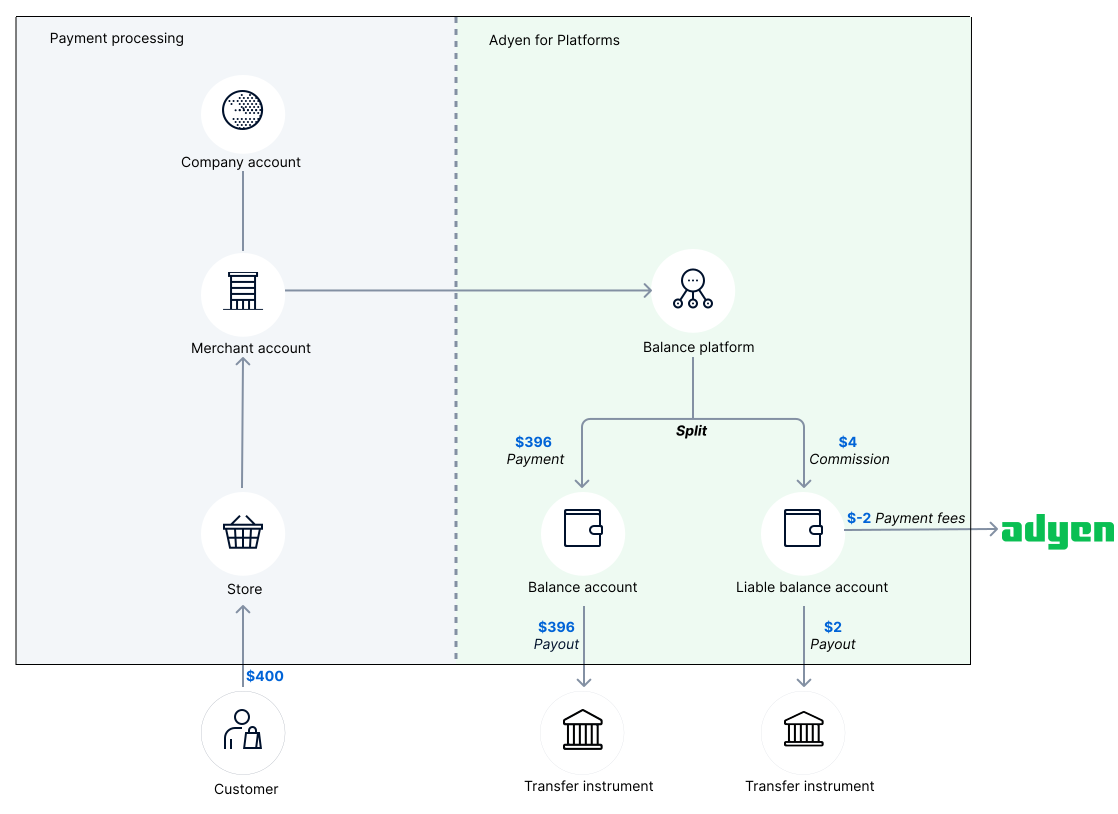
- The customer pays USD 400.00 for the goods or services.
- The payment is processed through Adyen's payment processing platform.
- Based on the split instructions included in the payment request, we book the following amounts to the balance accounts in your balance platform:
- USD 396.00 credited to your user's balance account
- USD 4.00 credited to your liable balance account as your commission
- USD 2.00 deducted from your liable balance account as the transaction fees
- The funds from the payment and commission settle in your user's balance account and in your liable balance account, respectively.
- The funds are paid out:
- The remaining USD 2.00 to your transfer instrument
- USD 396.00 to your user's transfer instrument