


This page provides an overview of best practices for onboarding your users in the United Kingdom. Adyen tries to automatically verify the submitted information. If automatic verification fails, Adyen starts a manual review and can ask for a supporting document.
Fix verification errors
When a verification check fails, Adyen returns an error. For more information about how Adyen verifies your users, see verification process. The following steps are the general process to resolve an error for any verification type:
- Correct any typos or incorrectly filled information that does not match the validated data exactly, for example, the address on a document. Then submit the information again.
- If verification still fails, ask your user to provide a supporting document. The organization, individual, and bank account verification sections describe which document to provide.
- Wait for Adyen to complete the manual review. This usually takes 24–48 hours.
Organization verification
Adyen verifies the name of the entity as registered with HM Revenue and Customs (HMRC). Provide the registration number based on the entity type:
| Entity type | Registration number required |
|---|---|
| Organizations | Company number or Unique Taxpayer Reference (UTR) |
| Associations and non-profits | Company number or Charity Number |
| Schools | UK Provider Reference Number (UKPRN) and Unique Reference Number (URN) |
| Sole proprietorships | UTR |
| Unincorporated partnerships | VAT number or UTR |
| Incorporated partnerships | Company Registration Number (CRN) or UTR |
You must provide the VAT number for all entity types. If the VAT number is absent, select one of the following reasons:
- Earnings are below the mandatory indirect tax registration threshold in this country.
- The goods or services provided are exempt from VAT or GST.
The following table shows the accepted registration number formats by entity type:
| Entity type | Business Number | Charity Number | CRN | UKPRN / URN | UTR | VAT Number |
|---|---|---|---|---|---|---|
| Organization | ✓ | |||||
| Association / non-profit | ✓ | ✓ | ✓ | |||
| School | ✓ | |||||
| Sole proprietorship | ✓ | |||||
| Unincorporated partnership | ✓ | ✓ | ||||
| Incorporated partnership | ✓ | ✓ | ✓ |
The following table shows the registered business structures accepted by Adyen:
| Category | Accepted forms |
|---|---|
| Organization | privateCompany (LTD, LLC), partnershipIncorporated (LLP, SLP), nonProfit (CIO, CIC), associationIncorporated (Co-op), listedPublicCompany (PLC), governmentalOrganization |
| Sole proprietorship | soleProprietorship |
| Partnership | unincorporatedPartnership (LP, PFLP, GP) |
Additional requirements that can apply:
- Ownership structure in cases where enhanced due diligence is required.
- Stock data for listed public companies.
- Authorized signatories (banking capabilities only).
- Legally registered city (banking capabilities only).
- Source of funds used to fund the account (Issuing or Business Accounts only).
- Directors of the entity.
Upload a document
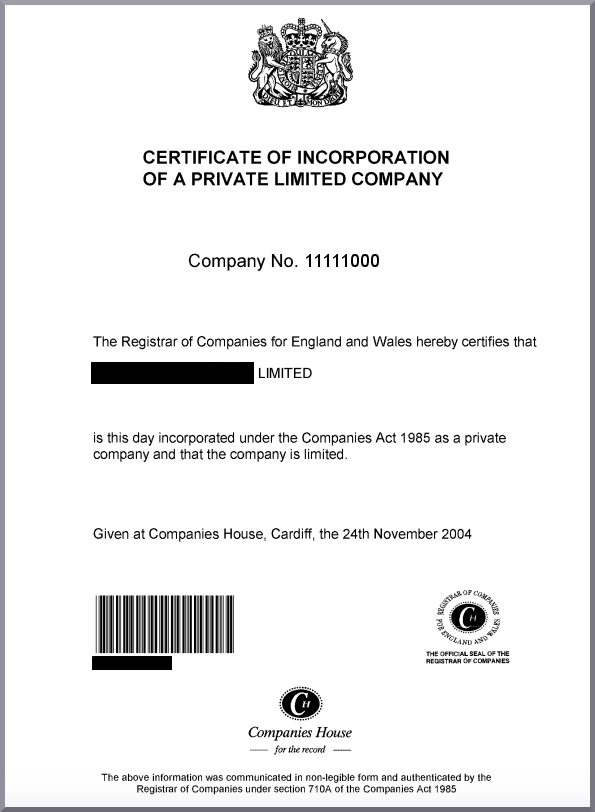
If automatic verification fails and the information entered is accurate, your user must provide a document from HMRC or Companies House that contains the legal name and company number.
Troubleshooting common errors
| Error | Best practice |
|---|---|
| Legal business name | Use the full name exactly as it appears on official documents. Do not use abbreviated or shortened names. Do not enter a doing business as (DBA) name in this field. Use the separate DBA field. |
| Entity types | Choose the correct entity type. Adyen verifies specific statuses for organizations, non-profits, and partnerships. |
| UTR forms | Make sure the UTR form is fully visible and electronically signed. Sole trader tax returns are not supported because they are self-filled. Tax calculation documents downloaded from the HMRC website are accepted. |
| VAT numbers | If a VAT number is absent, select one of the following reasons: earnings are below the mandatory indirect tax registration threshold in this country, or the provided goods or services are exempt from VAT or GST. |
Individual verification
Adyen verifies the identity of individual and sole proprietor account holders. If the account holder is an organization, Adyen verifies the identity of the following individuals: all the associated ultimate beneficial owners (UBOs) through control or ownership and at least one signatory.
The following information always requires verification:
- Legal name and date of birth: The individual's full legal name and date of birth.
- Country of residence: The individual's primary country of residence through their address details.
Verification options
Troubleshooting common errors
| Error | Best practice |
|---|---|
The ID document was of too low quality |
The uploaded document must be a high-quality original image or direct scan. Indirect copies, for example a photo pasted onto a PDF file, cannot be verified. Ask your user to provide a photo when possible. All details (name, photo, document information) must be fully visible and clear. |
The name didn't match the one on the ID document or The name and date of birth couldn't be verified or The name and residence country couldn't be verified |
Make sure that the full legal name, date of birth, and country of residence are submitted exactly as they appear on the individual's government-issued identification. Do not submit nicknames, abbreviations, or titles. |
Bank account verification
Adyen verifies the bank account where your user receives their payouts.
Verification options
Troubleshooting common errors
| Error | Best practice |
|---|---|
Bank account holder does not match the document |
The bank account must be held in the name of the onboarded legal entity. Adyen cannot disburse funds to accounts held by individuals, subsidiaries, or parent companies unless an exception is granted. Exceptions apply to sole proprietorships (payouts to the owner are allowed) and payouts to accounts held under a registered trading name (DBA) if it is a genuine trading name. Onboard new account holders for each separate legal entity. |
The bank document wasn't a supported document type |
Use a bank statement or bank letter. These have the highest pass rates. Do not use photos of credit cards or emails. |
The bank document wasn't issued in the past 12 months |
Use a document issued or signed within the last 12 months. Make sure the date is clearly visible. Do not use edited or personalized documents. |